
Types of Acrylic Pools, Structural Panels & Geometries in Dubai
1. Material Science: Why Cast PMMA Over Laminated Glass
1.1 Optical Clarity
- Light transmission: Cast PMMA transmits approximately 92-93% of visible light, comparable to or better than low-iron glass at equivalent thickness.
- No green tint or iron edge effect: Laminated glass built from multiple plies shows a green cast and visible edge banding. A 300-500 mm laminated glass stack would become noticeably dark.
- Refractive index (~1.49): This is close to that of water (~1.33). The panel causes minimal visual distortion, so underwater views look natural, with less of the “magnifying” effect seen in some glass.
- Thickness scalability: PMMA can be cast in monolithic sections of 100-800+ mm with no interlayers. Laminated glass depends on PVB/SGP interlayers that can haze, delaminate, or yellow over time in wet, high-heat conditions.
1.2 UV Resistance
- Cast PMMA is inherently UV-stable. It is not dependent on additives that bleach out, and it does not yellow measurably over decades of exposure.
- Dubai’s UV index regularly reaches 11+ for much of the year. Laminated glass interlayers (PVB/EVA) can discolor or lose adhesion at the edges under sustained UV and humidity, especially where the edge is exposed in a pool rebate.
- Premium cast grades are produced as a block through controlled polymerization, giving a very uniform molecular structure and consistent performance across the full thickness.
1.3 Thermal Expansion in Hot Climates
- Coefficient of thermal expansion: approximately 70-77 × 10⁻⁶ /K for PMMA, versus ~9 × 10⁻⁶ /K for glass. That is roughly 8× higher.
- Practical effect: A 6 m panel with a 40 K temperature swing can change length by roughly 17-18 mm. This must be accommodated in the design.
- Design responses:
- Perimeter expansion gaps and compressible sealant joints sized for the full thermal range.
- Floating rebate design so the panel is not rigidly restrained.
- Shading or water-contact strategies to reduce thermal gradients between the wet and dry faces.
- Specifying cast (not extruded) PMMA, which has higher molecular weight, better creep resistance, and superior long-term load behavior.
- Service temperature: Typical continuous service limit is around 80 °C, well above any pool or ambient condition in the UAE, although dark-surfaced external panels in direct summer sun need thermal assessment.
1.4 Additional Structural and Practical Advantages
- Weight: About half the density of glass (~1.19 g/cm³ vs ~2.5 g/cm³), which eases handling and reduces dead load on the structure.
- Impact behavior: PMMA is ductile rather than brittle in failure modes and does not shatter into dangerous shards. It tolerates local damage more gracefully.
- Repairability: Surface scratches can be polished out in situ, even underwater by specialist divers. Laminated glass cannot be refinished.
- Seamless jointing: Cast sheets can be chemically bonded (polymerized joint) into a monolithic assembly with near-invisible joints, which is not possible with glass.
- Creep consideration: PMMA is viscoelastic, so design stress is limited to a fraction of short-term strength for long-duration water loads. This is a core part of panel sizing.
Types of Acrylic Pools, Structural Panels & Geometries in Dubai
2. Panel Geometries: Engineering, Limits & Use Cases
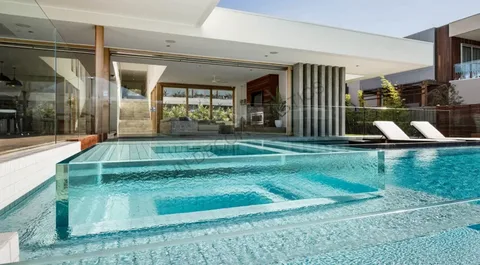
2.1 Flat Windows / Viewing Walls
Engineering
- The most common and most economical geometry. The panel is designed as a plate supported on its edges in a rebate, loaded by hydrostatic pressure that increases linearly with depth.
- Thickness is governed by: water depth, panel span (width × height), support condition (3-side, 4-side), long-term allowable stress, and deflection limit.
- Sizing is checked by finite element analysis (FEA) and verified against recognized design methodology (such as ANSI Z124.9 principles, or the manufacturer’s engineered design basis).
- Design stress for long-term water load is typically limited to roughly 10-12 MPa or less, with substantial safety factors.
Structural Limits (indicative)
- Thickness ranges from about 50 mm for shallow, small windows to 300-500 mm for deep, large viewing walls.
- Single-piece panels can reach 12+ m in length depending on manufacturer, casting capacity, and transport logistics. Larger spans are normally built by bonding multiple sheets in a factory-controlled process.
- Deflection limits are kept tight (commonly span/200 or stricter) to protect seals and keep the visual straight.
Use Cases
- Residential villa pools with a lounge-level or basement viewing window
- Hotel and restaurant underwater dining or bar views
- Gym and spa installations with a lap-pool viewing section
- Commercial aquarium-style feature walls
2.2 L-Shaped & U-Shaped Panels (Molecularly Bonded Corners)
Engineering
- Individual cast sheets are joined by thermal-chemical polymerization, forming a corner or channel that behaves as one monolithic piece. A properly executed bond approaches the strength of the parent material.
- Because the geometry wraps around a corner, stress concentration at the internal radius must be evaluated carefully in FEA. Designers often add a radiused or chamfered inner corner to avoid notch effects.
- Bonding is done in factory conditions (controlled temperature, humidity, and dust) followed by annealing to relieve residual stress. Site bonding is not an equivalent substitute for structural joints.
Structural Limits (indicative)
- The joint is typically the critical design zone. Quality is verified through destructive test coupons, ultrasonic inspection, and visual polarized-light stress checks.
- Overall sizes are limited by oven capacity, handling weight, and transport. Large U-sections are frequently built as multiple factory assemblies and joined on site by qualified technicians.
Use Cases
- L-shaped: Corner windows where the pool wraps around a room, giving two-direction views. Common in luxury villas.
- U-shaped: “Swim-through” or “immersion” bays where occupants stand inside a pocket of the pool, surrounded on three sides by water. Popular in hospitality and signature residences.
- Glass-free corners create a seamless panoramic effect with no vertical mullions.
2.3 Curved, Cylindrical & Thermoformed Panels
Engineering
- Thermoforming: Sheet is heated to its forming temperature (approx. 150-180 °C) in controlled ovens and shaped over a mold, then cooled slowly and annealed. Bend radius and thickness are limited by forming capacity and the need to avoid surface defects and residual stress.
- Cylindrical panels (tunnels, columns, tubes): Curved geometry carries load largely in membrane (compressive hoop) action, which is structurally efficient. PMMA performs very well in compression, so a cylinder can be thinner than a flat panel of comparable size.
- Segmented or machined curves: For very large radii or thick sections, curved parts can be machined from thick cast blocks or assembled from bonded segments.
Structural Limits (indicative)
- Minimum bend radius depends on thickness; very thick sections require large radii or machining instead of forming.
- Optical distortion must be managed. Thermoforming can introduce slight waviness, so premium projects use controlled forming, annealing, and optical inspection.
- Free edges of curved panels need careful rebate and support design to prevent point loads.
Use Cases
- Underwater tunnels and walk-through arches
- Half-cylinder bay windows protruding into the pool
- Circular portholes and feature lenses
- Curved infinity-edge wraps and sculptural water features
- Round pool “bubbles” for architectural statement pieces
2.4 Thick-Block Floor Panels (Cantilevered Structures)
Engineering
- Used where the pool floor itself is transparent or where a section of the pool projects beyond the building envelope.
- Panels behave as thick plates in bending under combined loading: hydrostatic pressure, self-weight, and, for walkable designs, live loads.
- Thicknesses are typically significantly greater than wall panels (often 200-500+ mm) because bending governs, and long-term creep must be addressed.
- The surrounding structure (steel or reinforced concrete) must be designed for very low differential deflection, since excess movement of the supporting frame overstresses the acrylic and its seals.
- Load path discipline: Support the panel evenly using a continuous bearing surface with a compatible bearing material, avoiding hard point contact.
Structural Limits (indicative)
- Governed by deflection and long-term stress, not ultimate strength.
- Overhang length is limited by the stiffness of the supporting steel or concrete cantilever, not just by the acrylic.
- Transport and installation weight can be considerable (multi-ton panels), requiring heavy lifting plans, crane access, and sometimes sequential installation.
Use Cases
- Cantilevered rooftop pools that extend over the building edge on high-rise or villa developments
- Glass-bottom (acrylic-bottom) sections over a lower-level lounge, lobby, or atrium
- Sky-pool bridges connecting towers
- Hospitality “hero shots” on Palm Jumeirah, Downtown Dubai, Business Bay, and Saadiyat Island
Types of Acrylic Pools, Structural Panels & Geometries in Dubai
3. Pool Configurations: Popular Architectural Types
3.1 Infinity / Overflow Pools
- Concept: One edge appears to merge with the horizon via a vanishing edge with a catch trough below.
- Acrylic role: A transparent edge or end-wall can give a viewing face from below or from the side, enhancing the effect on towers and waterfront villas.
- Engineering considerations:
- Hydraulic design for surge/balance tanks, weir height, and trough sizing
- Wind-driven water movement, especially at height
- Evaporation losses in the UAE climate, calling for automatic top-up and good water chemistry control
- Edge details that minimize visible sealant lines
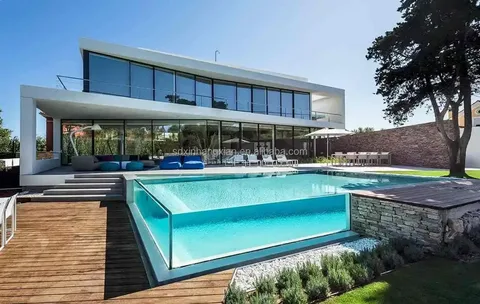
3.2 Cantilevered / Rooftop Pools
- Concept: The pool projects beyond the building line, sometimes with a transparent underside or end-wall.
- Engineering considerations:
- Global structure: Cantilever design, deflection control, vibration, and wind and seismic assessment per UAE codes
- Dead load management: A filled pool is extremely heavy (1 m³ of water ≈ 1 tonne), so the transfer structure design is critical
- Façade coordination: Waterproofing, thermal movement, drainage, and fire/life-safety integration
- Safety systems such as redundant seals, leak detection, and monitored water levels
- Use case: Landmark hotels, branded residences, penthouses, and sky villas.
3.3 Above-Ground & Modular Pools
- Concept: Self-contained acrylic or acrylic-and-steel pools placed on a podium, terrace, or lawn without deep excavation.
- Advantages:
- Faster construction, with lower dependence on subsurface conditions
- Ideal for retrofits and for terraces with load limits
- Prefabricated modules can be relocated or re-used
- Considerations:
- Structural frame detailing, with full-wall hydrostatic pressure carried by the frame and panels rather than soil backfill
- Thermal management, since exposed walls absorb more solar gain
- Architectural finishing: cladding, timber, stone, or landscaping to integrate the structure
- Use case: Boutique hotels, rooftop lounges, show villas, and compact luxury homes.
3.4 Basement Viewing Windows
- Concept: An acrylic window set into a pool wall allows viewing from a basement lounge, home cinema, gym, or car gallery.
- Engineering considerations:
- Water ingress management: A secondary drainage and leak-detection layer in the room-side structure
- Condensation control: HVAC and dehumidification because of cold glazing surfaces in a humid environment
- Lighting design: Balanced exterior and interior lighting to avoid reflections and preserve the view
- Access and maintenance: Provision for diver or robotic cleaning, and for panel inspection
- Use case: Private residences, wellness suites, and hospitality spaces seeking a signature “aquarium room” effect.
4. Installation & Waterproofing
4.1 Rebate Design
- The panel sits in a precisely machined rebate (recess) formed in the reinforced concrete or steel structure.
- Key requirements:
- Bearing depth adequate for load transfer, usually a proportion of panel thickness set by the engineer
- Flatness and tolerances of the rebate faces held tightly so the panel does not take uneven point loads
- Compatible bearing strips (for example, EPDM or other engineered elastomer shims) to give a uniform, non-hard contact
- Edge clearances on all sides to allow thermal expansion and construction tolerance
- Water-side and dry-side sealant joints with the correct depth-to-width ratio
4.2 Chemical Sealants & Gaskets
- Structural/pool-grade silicone: Neutral-cure, acrylic-compatible silicone is the typical primary seal. Incompatible products can cause stress cracking (crazing) in PMMA, so compatibility testing and manufacturer approval are essential.
- EPDM profiles and gaskets: Used for bearing, compression seals, and secondary barriers. Selected for UV, ozone, and chlorine resistance.
- Backer rods and bond breakers: Ensure the sealant bonds on two faces only, allowing movement.
- Primers and surface prep: Applied per the sealant supplier’s specification.
- Maintenance: Sealants are a service component. Periodic inspection and eventual replacement should be planned in the maintenance schedule.
4.3 Waterproofing Strategy
- Multi-layer approach: Structural concrete or steel, crystalline or cementitious waterproofing, membrane systems at the rebate perimeter, and tertiary drainage with leak detection where the space behind is occupied.
- Water testing: A staged flood test (commonly 24-72 hours or as specified) before finishes and handover, with monitoring of levels, deflection, and seals.
- Installation controls: Cleanliness, temperature limits during sealant application, protective films left on the acrylic until final stages, and careful handling to prevent surface scratching.
4.4 Municipality & Regulatory Compliance (Dubai / UAE)
- Dubai Municipality (DM) requirements typically include:
- Structural calculations and drawings stamped by a UAE-licensed consulting engineer
- Manufacturer’s design certification for the acrylic panels (design methodology, material certification, test data)
- Review of the supporting structure (cantilevers, slabs, transfer beams) as part of the overall building approvals
- Compliance with DM swimming pool regulations covering safety, water treatment, hygiene, and signage
- Other relevant authorities, depending on location:
- Dubai Civil Defence for life-safety aspects in commercial and hospitality projects
- DEWA for electrical and water interfaces
- Abu Dhabi projects: ADM, DMT, and the Abu Dhabi Building Code
- Master developer NOCs (Emaar, Nakheel, Meraas, etc.) for design review, particularly on Palm Jumeirah and Dubai Hills
- Typical documentation package:
- Material test certificates and traceability records
- FEA/calc reports with load cases and safety factors
- Shop drawings, rebate details, and installation method statements
- Quality plans, inspection and test plans (ITP), and as-built records
- Warranty and maintenance manuals
Always confirm current requirements directly with the relevant authority and your appointed structural consultant, as codes and submission processes are updated periodically.
Summary: Al Naseem Pools Design Philosophy
| Aspect | Approach |
|---|---|
| Material | Cast PMMA for clarity, UV stability, and monolithic bonding |
| Geometry | Selected on structural efficiency and architectural intent |
| Engineering | FEA-verified, creep-aware, with conservative safety factors |
| Climate | Thermal movement and UV exposure designed in from day one |
| Compliance | Full documentation aligned to Dubai Municipality and UAE authorities |
| Lifecycle | Planned inspection, sealant renewal, and surface maintenance |
Al Naseem Pools delivers acrylic pool solutions where engineering precision meets architectural ambition, from private villa viewing windows to cantilevered sky pools across Dubai and the wider UAE.
Types of Acrylic Pools, Structural Panels & Geometries in Dubai



One Response